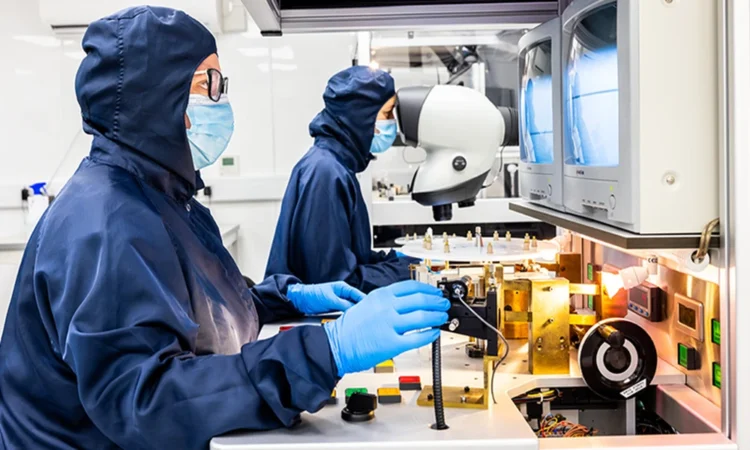
In the supply chain for a medical device that will be used in a clinical environment, the assembly step is the one where the fully formed components come together into the product that a clinician will ultimately handle and use. The quality of this assembly step, including the environmental controls in place, the training of the assemblers, and the inspection protocols applied, determines whether the device that leaves the manufacturing facility matches the validated design intent that the device file documents.
Medical device clean room assembly is the controlled assembly environment that manages particulate and biological contamination during this critical step. The classification of the cleanroom determines the maximum allowable particle count in the air during assembly; the assembly protocols define how the validated design is assembled from its components; and the trained assemblers execute these protocols consistently across every unit in the production batch.
AMT’s clean room assembly capability serves medical device OEMs whose products require assembly in a controlled environment, whether the classification requirement is driven by the device’s sterility pathway, the sensitivity of its electronic components, or the clinical application that determines what contamination levels are acceptable.
Clean room Classification and Medical Device Categories
ISO 14644-1 defines clean room classifications by the maximum allowable particle concentration at a specified particle size in one cubic metre of air. ISO Class 5 is the cleanest classification, permitting a maximum of 3,520 particles per cubic metre at 0.5 micrometres and above. ISO Class 8, at 3,520,000 particles per cubic metre, is the least demanding certified clean room classification.
Medical device assembly is typically conducted in ISO Class 7 or ISO Class 8 environments for most device categories, with ISO Class 5 or 6 required for devices that are assembled with directly or indirectly patient-contacting components in their critical zones.
Medical device cleanroom assembly at AMT is performed in cleanroom environments maintained and monitored to the classification appropriate for the products being assembled. Environmental monitoring records demonstrate ongoing compliance with the classification limits throughout each production period.
Material Handling in Cleanrooms
The introduction of materials and components into the cleanroom is one of the highest-risk moments for contamination introduction. Components arriving from upstream manufacturing operations are packaged and cleaned before entry, with the packaging removed in the clean room ante-room to prevent external contamination from entering the controlled area.
Components that are sensitive to electrostatic discharge are handled with appropriate antistatic precautions, including grounded workstations, ionised air, and appropriate gloves, in addition to the contamination controls applicable to all clean room operations.
AMT’s material handling procedures are documented as part of the quality management system and verified during internal audit and customer qualification audits.
Assembly Process Validation
The assembly process for a medical device must be validated, which means demonstrating that the assembly process consistently produces assemblies meeting the acceptance criteria when performed within the defined process parameters by trained personnel. Validation involves executing the process under controlled conditions with a defined sample size and demonstrating that all assemblies produced meet the acceptance criteria.
For assembly operations that are critical to device function or safety, IQ-OQ-PQ validation (Installation Qualification, Operational Qualification, Performance Qualification) provides the documented framework for this demonstration. AMT’s process validation approach follows this framework for new products and for significant changes to existing assembly processes.
Inspection at Assembly
In-process and final inspection in medical device cleanroom assembly verifies that the assembled device meets its acceptance criteria before it proceeds to the next stage. Inspection may involve dimensional checking, functional testing, visual inspection under specified illumination conditions, or leak testing depending on the device type.
Non-conforming assemblies identified at inspection are segregated, reviewed, and dispositioned through the nonconformance procedure. Yield data from assembly inspection is monitored as a process performance indicator and used to trigger process improvement where yields fall below targets.
For medical device OEMs who need medical device cleanroom assembly in a qualified, controlled environment with validated assembly processes, trained operators, and the documentation infrastructure that regulatory compliance requires, AMT provides the Singapore-based cleanroom assembly capability that medical device production demands.